tjabo.dev
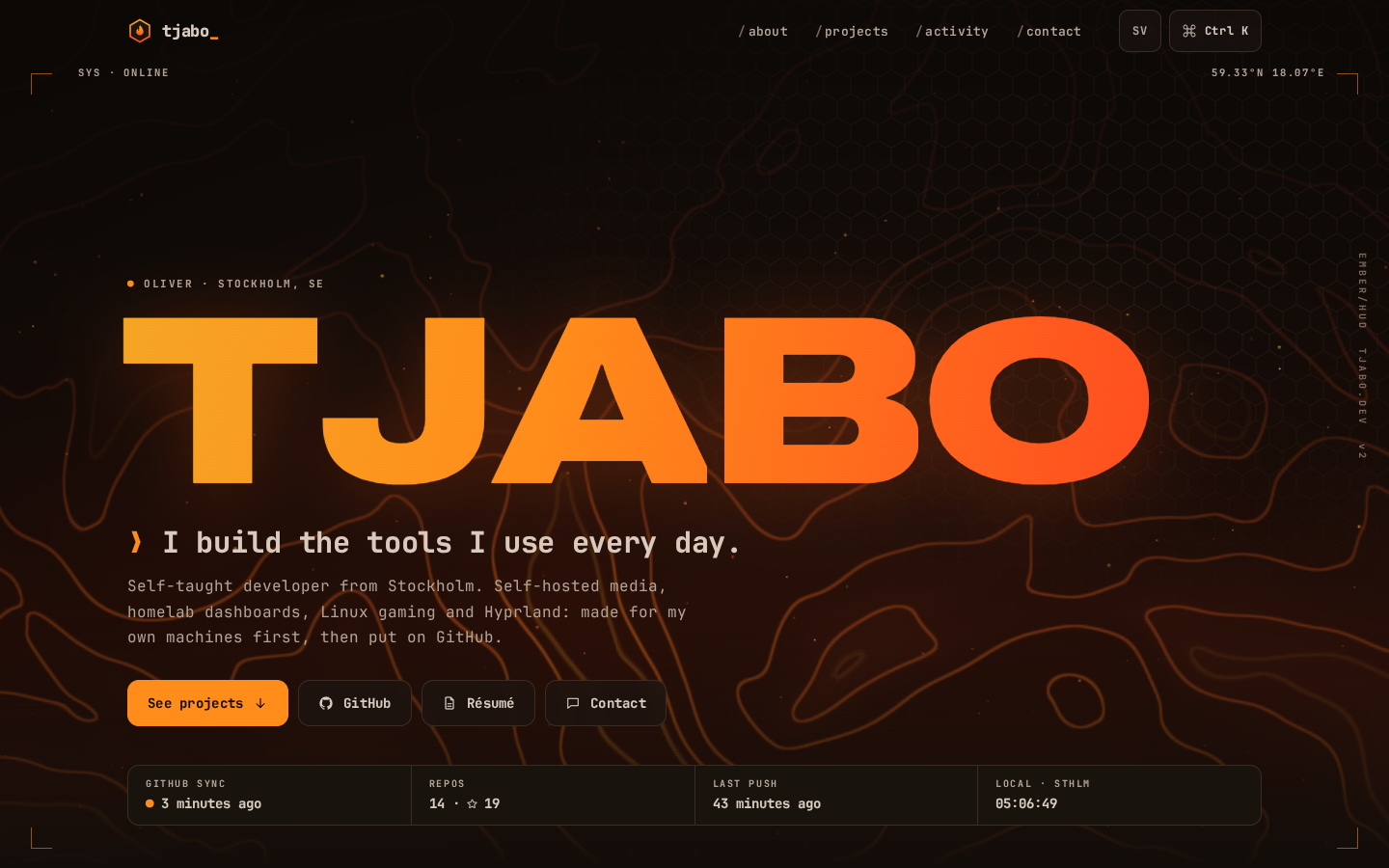
My portfolio: a hand-written WebGL ember hero, a ⌘K command palette, a hidden terminal and a project grid that keeps itself in sync with every public repo on my GitHub. Same palette and attitude as my Hyprland rice, ember.
Live: tjabo.dev · English at /, Swedish at /sv
Features
- Thermal hero shader. WebGL2, written by hand: domain-warped noise drawn as glowing isotherms with a few hundred embers rising through it. The cursor is a heat source and scrolling speeds up the updraft. It renders at a reduced internal resolution (about 0.55 MP on desktop, 0.2 MP on phones), adapts if frames run slow, pauses off-screen and in hidden tabs, and falls back to a static gradient on software renderers, tiny devices, data-saver or without WebGL2.
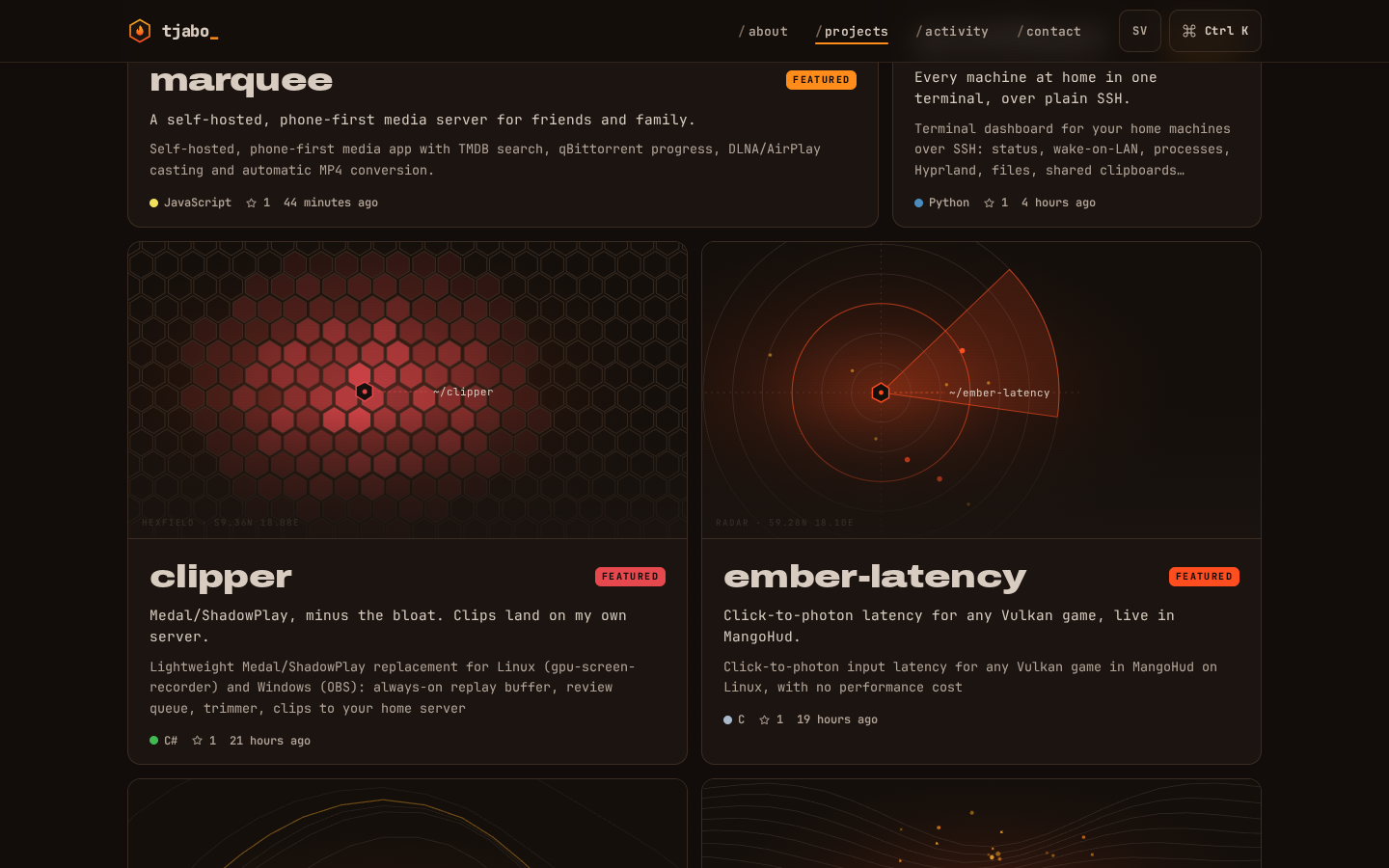
- Projects straight from GitHub. Every public, non-fork repo shows up on its own, in a bento grid with filters (language, topic) and sorting (featured, recently updated, most stars). Featured repos get big cards with the first screenshot from their README, or a generated cover seeded by the repo name.
- A page per repo at
/projects/<repo>: the rendered README (GitHub-flavoured markdown, highlighted code, relative links and images rewritten to GitHub), stats, CI status of the default branch, the latest release, an install snippet (taken from the README's Install section when it has one), languages, recent commits, related projects and previous/next navigation. - Activity: the public contribution calendar as an ember heatmap, a feed of recent commits and releases across all repos, and totals (repos, stars, languages counted per repo, not by bytes).
- ⌘K / Ctrl+K command palette: jump to any project or section, switch language, copy Discord or email, open the résumé, toggle motion, open the terminal.
- Hidden terminal: press
</kbd>.help,ls projects,cat,open,neofetch,stats,lang sv,motion off`, tab completion and history. - Motion that respects you: scroll reveals, magnetic buttons, cards that tilt and glow under the cursor, route transitions. All of it follows
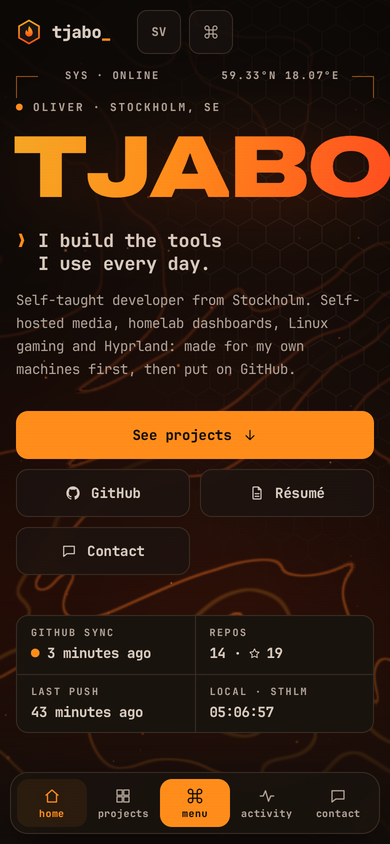
prefers-reduced-motionand the motion toggle (saved per browser). - Phone first: works from 360 px wide, a bottom dock within thumb reach, no horizontal scrolling.
- Shareable: generated Open Graph images for every page and project,
sitemap.xml,robots.txt, an RSS feed of releases (/feed.xml) and JSON-LD (Person,SoftwareSourceCode). - Contact form → Discord through a webhook, rate limited per IP (3 per 5 minutes), with a honeypot. Visitors can never ping
@everyone.
Stack
Next.js 16 (App Router) and React 19, plain CSS, and three server-only libraries: marked + highlight.js for READMEs and sanitize-html to keep them safe. No CSS framework, no animation library, no WebGL library. Fonts (JetBrains Mono, Archivo Expanded) are self-hosted subsets. Initial JS on a modern browser is about 158 kB gzipped, ~116 kB of which is React and Next itself; the shader, palette and terminal load lazily. Lighthouse: performance 96 (mobile) / 100 (desktop); accessibility, best practices and SEO 97–100.
How the GitHub sync works
GitHub GraphQL ──► lib/github.js ──► memory ──► .cache/github.json ──► pages (ISR, 1 h)
     ▲                 ▲
     │                 └── POST /api/github (webhook, HMAC-checked) → refetch + revalidate every page
└── github.com/users/<owner>/contributions (public calendar)- On the server only.
lib/github.jsasks the GraphQL API for the owner's repositories withprivacy: PUBLIC, isFork: false, then filters again by each repo's ownisPrivate/isForkflags (a repo with unknown flags is dropped) and thehiddenlist. Nothing is fetched from the browser, and private repo names or counts never reach a page. - Per repo: description, topics, primary and all languages, stars, forks, last push, latest releases, CI status of the default branch (
statusCheckRollup), homepage, license, recent commits and the README, all in one query. - Lines of code (
lib/loc.js): GitHub has no API for it, so each repo's tarball is streamed from codeload.github.com (public, no token, outside the API rate limit) through gunzip and a small tar reader, counting non-blank lines in source files. Docs, data/config files (Markdown, JSON, YAML, TOML), lockfiles, minified bundles, vendored or build folders and binaries are skipped; extensionless scripts count when their shebang names a known language. Counts are cached per commit inCACHE_DIR/loc.json, so a sync only downloads repos that changed, waits at most 25 s and lets slower counts finish in the background. Hovering the stat shows the file count and top languages. - The heatmap comes from GitHub's public contributions page, so it shows exactly what anyone sees on the profile, never private work.
- Caching: results live in memory and in
CACHE_DIR/github.jsonfor 30 minutes (GITHUB_CACHE_TTL_MINUTES). If GitHub is down, rate-limited or the token is bad, pages keep the last good data from disk; a failure backs off for two minutes instead of retrying on every request. - Freshness: pages are regenerated at most hourly (ISR), and a GitHub webhook makes it instant: a push, release or repo change refetches and drops every cached page within seconds. A new public repo appears on the next hourly refresh even without a webhook.
- No token? It still works through the unauthenticated REST API, minus CI status, release lists and the per-language split.
Webhook
The endpoint is POST https://tjabo.dev/api/github. It checks X-Hub-Signature-256 (HMAC-SHA256 of the raw body with GITHUB_WEBHOOK_SECRET) and answers 401 to anything unsigned.
Add it to every public repo at once (re-run after creating new repos; it updates existing hooks instead of duplicating them):
GITHUB_WEBHOOK_SECRET=<same value as on the server> scripts/github-webhooks.shOr by hand, per repo: Settings → Webhooks → Add webhook, payload URL https://tjabo.dev/api/github, content type application/json, the secret, and the events Pushes, Releases, Repositories, Stars, Workflow runs. GitHub sends a ping first; the site answers {"ok":true,"pong":true}.
Configuration
site.config.json (curation only)
Anything not listed here still appears, using what the API says.
| Key | What it does |
|---|---|
owner |
GitHub user whose public repos are shown |
featured |
Repos that get big cards, in this order |
hidden |
Repos never shown (old school projects, the profile repo) |
overrides.<repo> |
tagline, tagline_sv, description, description_sv, cover (image URL), accent (hex colour), install (snippet) |
contact |
GitHub, LinkedIn, Instagram, Discord username, email (left null = no email shown) |
Environment (.env, see .env.example)
| Variable | |
|---|---|
DISCORD_WEBHOOK_URL |
Where contact form messages go |
DISCORD_MENTION_USER_ID |
Discord user pinged on each message (optional) |
GITHUB_TOKEN |
Fine-grained token with read-only access to public repositories (no other permissions) |
GITHUB_WEBHOOK_SECRET |
Shared secret for /api/github |
GITHUB_OWNER, SITE_URL |
Override owner / siteUrl from the config |
CACHE_DIR, GITHUB_CACHE_TTL_MINUTES |
Where and how long GitHub data is cached |
LOC_COUNT |
0 turns the lines-of-code count off (no tarball downloads) |
Add ?perf to the URL to log the shader's frame time to the console.
Development
cp .env.example .env     # fill in what you need; everything works without a token
npm install
npm run dev              # http://localhost:3000
npm test                 # node:test: GitHub filtering, README rewriting, webhook signatures, rate limit
npm run build && npm run check   # production build, then a smoke test of the key routes
Needs Node 22.18 or newer. CI runs the tests, the build and the smoke test on every push.
Résumé
public/en-resume.pdf and public/sv-resume.pdf (the Résumé button and ⌘K action) are built from
resume/resume.json: one shared block (name, contact links) plus one block per language. Edit it, then:
npm run resume            # writes resume/out/{en,sv}.html, then prints both A4 PDFs with Chrome or Edge
npm run resume -- --html  # HTML only, to print on another machine (CHROME=/path/to/chrome picks the browser)
The HTML embeds the site's own fonts (Archivo Expanded, JetBrains Mono) plus a Noto Sans subset in resume/fonts,
so it prints the same anywhere. Keep it to one page: pdfinfo public/en-resume.pdf | grep Pages.
Deploy
The site runs on a Windows box behind Cloudflare, as a scheduled task that starts at boot. One command deploys:
powershell -ExecutionPolicy Bypass -File C:\tjabo.dev\deploy.ps1It pulls, builds the new version in its own folder (releases\<time>-<sha>: git archive, npm ci, tests, next build), and only then stops the site, points the current junction at the new release and starts the task again. The new build must answer /api/health with its own BUILD_ID within 90 seconds or the previous release is switched back in. A failed build never touches the live site. The last three releases are kept.
deploy.ps1 -SetupTask(re)creates the boot task,-Rollbackswitches to the previous release,-NoPulldeploys what's checked out.start-tjabo.dev.cmdis what the task runs:npm start(port 8000) insidecurrent\, restarted if it exits, logging tologs\tjabo.dev.log..envsits next todeploy.ps1and is copied into each release;CACHE_DIRshould point at a folder outside the releases so the GitHub cache survives deploys.
On Linux or anywhere else it's a normal Next.js app: npm ci && npm run build && npm start.
License
Code: MIT. The fonts in app/fonts and assets/og are under the SIL Open Font License (licenses next to them). The résumés and the copy about me are mine.