MAGI Consensus


A local voice assistant that never acts alone: three LLM units vote on every action, and it runs only with 2 of 3. Your own phrases ("MAGI, workspace 3 and fullscreen roblox") skip the vote and run at once.
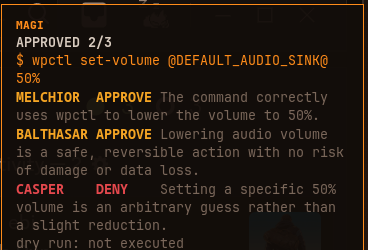
"uh turn it down a bit" → the planner proposed a fixed 50 %; CASPER (intent) objected, the other two outvoted it. Dry run, so nothing ran.
Features
- A general voice assistant. Talk to it like a person: questions, small talk and statements get a
spoken answer; only clear requests to do something become commands. It answers in the language you
spoke (one TTS voice per language), remembers the last few exchanges for follow-ups ("what did I just
say my favourite food was?"), and asks you to repeat garbled speech instead of guessing a command.
Mix languages in one breath ("你好吗, answer in English"), set lasting rules ("from now on answer my
Chinese in English") and notes ("remember that my sister is Anna");
consensus noteslists them. - Two-of-three rule. A planner model turns your request into one shell command; MELCHIOR (is it correct?), BALTHASAR (is it safe?) and CASPER (is it what you meant?) vote independently. A unit that errors counts as DENY.
- Hard rules before any vote.
sudo/doas/pkexec... never run, not even allowlisted. Destructive commands (rm,dd,kill,systemctl stop,git push --force,> file...) and interpreters that hide what runs (bash -c,eval,| sh) are refused unless they match an allowlist you wrote. Quotes and paths don't fool it (s''udo,/usr/bin/sudo,$(sudo …)). - Fast path for your own phrases.
[[commands]]you write (clip that,skip,mute my mic,workspace {n},fullscreen {app}...) run in milliseconds with no model and no vote. Requests chain with "and" / "then" (open roblox and fullscreen it); only when every part matches does it take the fast path, anything else goes to the council. - Apps by name.
[[apps]]map names and aliases to windows (class / title regex, or a process below the window, so two gamescope games can be told apart) and launch commands. Open windows match by class even without an entry; "it" / "this" means the app of the previous step. - Always-on wake word.
consensus ears runlistens for "MAGI" with a 3 MB keyword-spotting model on the CPU (about 3 % of one core), then records until you stop talking and asks Whisper. Whisper must hear the wake word too, which cuts false wakes.consensus ears off/ "MAGI, stop listening". - Push to talk. Hold a key, talk, release: Whisper transcribes, the board decides, Piper answers.
- Vote card as a desktop notification (replaced in place: deliberating → voting → verdict).
- Everything logged:
votes.jsonl(request, command, each vote + reason, exit code, timings) andlast.jsonfor status bars. - Free when idle. Each request is one short process (only the optional wake-word listener stays running). Your model server decides when to unload (npukit and Ollama do it on their own).
- Local and generic. Any OpenAI-compatible endpoint; models, personas, tools, rules and voice are config.
Install
Needs Rust 1.88+, an OpenAI-compatible server with chat completions (JSON-schema output, e.g.
llama.cpp's llama-server) and, for voice,
/v1/audio/transcriptions (whisper.cpp's whisper-server --inference-path /v1/audio/transcriptions).
Recording uses pw-record (PipeWire), the card notify-send.
git clone https://github.com/Tjabooo/magi-consensus && cd magi-consensus
./install.sh            # builds, installs ~/.local/bin/consensus, writes an example config
Optional voice: Piper plus a voice from
piper-voices, then set voice.tts.
Usage
consensus ask "remind me in ten minutes to stretch"   # plan → rules → vote → run
consensus ask --dry-run "kill steam"                  # vote but never run
consensus check 'rm -rf ~/x'                          # hard rules only: "refused: destructive: rm"
consensus log                                          # last decisions: result, ✓✓✗, request, command
consensus hear sample.wav                              # test the speech endpoint
consensus ptt start | stop | toggle | cancel           # push to talk
consensus ask "workspace 3 and fullscreen roblox"      # your [[commands]]: runs at once, no vote
consensus ask --vote "skip"                            # force the council even for a fast phrase
consensus commands                                     # every fast phrase and app
consensus write --send -- 'an essay about Overwatch'  # compose text and type it into the focused window
consensus write --print discord -- 'a short poem'      # test the writer: print, type nothing
consensus write --stop                                 # stop a writer that is still typing ("stop writing")
consensus hush                                         # cut MAGI off (also: say "MAGI" while she talks)
consensus ears run                                     # always-on wake word (run it as a user service)
consensus ears on | off | toggle | status              # pause/resume the listener
consensus ears test sample.wav # where the wake word is heard (16 kHz mono)Typing vs writing
"type hello there" / "skriv hej" types exactly those words (wtype). "write an essay about Overwatch" /
"skriv en uppsats om Overwatch" / "write a reply saying I can't play tonight" describes text to create:
the planner runs consensus write -- 'BRIEF', which returns at once and leaves a worker that streams
the model's text and types it line by line into the window that was focused when you asked. The worker
writes in the language you spoke (or the one you asked for: "på engelska"), keeps chat messages under
Discord's 2000 characters, uses Shift+Enter for line breaks (one line in terminals and game chats),
stops typing and puts the whole text on the clipboard if the focus moves, and presses Enter at the end
only with --send. [write] model picks a different model for composing (busy_model + busy_when
swap it while a game runs). Before rules and votes, typing commands are repaired: a stray ' is
re-quoted, write … && wtype -k Return becomes --send, and Enter is dropped when the request never
said send.
Fast commands
[[apps]]
name = "roblox"
aliases = ["sober"]
class = "^(org\\.vinegarhq\\.Sober|gamescope)$"
process = "sober"                  # gamescope runs several games: look below the window's pid
launch = "flatpak run org.vinegarhq.Sober"

[[commands]]
say = ["clip [that|it]", "save [a] clip"]   # [optional]  (one|of)  {n} {level} {app} {text}
run = "my-clip-save"

[[commands]]
say = ["[whats|what_is] my ping"]           # a_b = "a b" inside brackets
run = "ping -c1 -q 1.1.1.1 | tail -1"
speak_output = true
Built in: workspace {n}, move {app} to workspace {n}, open/focus/close {app}, fullscreen {app},
exit fullscreen, play/pause/skip/previous, what's playing, volume, time. Your commands come first and
keep these (fast.own_commands_only = true replaces them). run is a shell command or a built-in
action: @workspace @focus @open @close @fullscreen @unfullscreen @move @special NAME.
Wake word
The listener uses a sherpa-onnx keyword-spotting model (linked statically, nothing to install):
mkdir -p ~/.local/share/magi-consensus && cd ~/.local/share/magi-consensus
curl -LO https://github.com/k2-fsa/sherpa-onnx/releases/download/kws-models/sherpa-onnx-kws-zipformer-gigaspeech-3.3M-2024-01-01.tar.bz2
tar xjf sherpa-onnx-kws-zipformer-gigaspeech-3.3M-2024-01-01.tar.bz2 && mv sherpa-onnx-kws-zipformer-gigaspeech-3.3M-2024-01-01 kws
Keywords are plain words, spelled the way they sound (ears.keywords = ["MAGGIE", "MAGI"]); they're
split into the model's BPE tokens from its bpe.model. Tune ears.threshold with consensus ears test
on a recording of your own voice. A systemd user unit:
[Unit]
Description=MAGI Consensus wake word
[Service]
ExecStart=%h/.local/bin/consensus ears run
Restart=always
[Install]
WantedBy=default.target
Muting the microphone at the source also deafens the listener, so "unmute my mic" can't work by voice.
Hyprland (Lua config), hold to talk:
hl.bind("SUPER + ALT + X", hl.dsp.exec_cmd(HOME .. "/.local/bin/consensus ptt start"))
hl.bind("SUPER + ALT + X", hl.dsp.exec_cmd(HOME .. "/.local/bin/consensus ptt stop"), { release = true })
Classic hyprland.conf: bind = SUPER ALT, X, exec, consensus ptt start and
bindr = SUPER ALT, X, exec, consensus ptt stop. Other compositors: bind consensus ptt toggle.
If a release gets lost (Hyprland skips it when SUPER or ALT comes up before X), a watcher reads the
key from the keyboard and stops the recording anyway: set [voice] hold_key if your key isn't X
(needs read access to /dev/input, i.e. the input group).
Exit codes: 0 ran / answered, 2 denied by vote, 3 refused by rule, 4 command failed, 1 model error.
Configuration
~/.config/magi-consensus/config.toml (or $MAGI_CONSENSUS_CONFIG). Only what you set overrides the
defaults; src/defaults.toml documents every key, and
examples/config.toml is a starting point.
| Section | What |
|---|---|
[endpoint] |
server URL, API key, timeout, Whisper model name, extra fields merged into every chat request |
[planner] |
model, temperature, reply style, conversation memory (memory_turns, memory_minutes), note_cues (words that make a note or language rule lasting) |
[[units]] |
name, model, temperature, persona prompt (any count; vote.needed sets the bar) |
[[tools]] |
what the planner may use: name, example command, one-line description |
[context] |
commands whose output the planner and units see (time, focused window...) |
[rules] |
never, destructive, opaque word lists, regex patterns, allow |
[run] |
shell, timeout, cwd, extra PATH entries |
[voice] |
recorder, max length, hold key, silence threshold, Whisper language/prompt, language_remap (re-transcribe misdetected languages, e.g. da = "sv"), TTS pipeline + tts_voices per reply language |
[fast] |
wake words and fillers stripped from requests, fullscreen command, done sound |
[[apps]] |
name, aliases, class / title regex, process, launch command |
[[commands]] |
phrases (say), run, spoken reply, speak_output |
[ears] |
keyword model dir, keywords, threshold, recorder, silence/timeout, wake sound |
[notify] |
card on/off, markup, colours |
How it works
See docs/DESIGN.md. In short: the planner and the units answer with JSON constrained
by a schema (response_format: json_schema), thinking off, a few dozen tokens each, so one 8–9B model
decides in about 3–5 s on a desktop GPU. Units vote in parallel. Commands run through sh -c in their
own process group with a timeout, stdin closed, output capped.
The hard rules are the security boundary; the vote is judgement on top. Don't widen the allowlist because the board seems sensible: three samples of one model can share a blind spot.
License
MIT